



- Marki
-



That is, everything you should know before buying.
At first, the subject of watches can seem quite overwhelming. What are the differences between different mechanisms, complications? What style to choose? We will try to answer these questions and make it easier to enter the world of timepieces.
Mechanical or quartz ?
Let’s start with the mechanism of the watch. Until the middle of the 20th century, all watches were equipped with a mechanism. Such watches do not require batteries, among this type of watches we distinguish those that are manually wound (hand-wound) and automatic (automatic). The latter wind themselves during daily activities, it is the movement that makes the watch go.
In the late 1950s, the SEIKO brand began work on a prototype quartz watch, the first widely available watch of this type on the market went into production only a decade later. How does such a timepiece work? In a nutshell: a battery causes the crystal to vibrate, which is converted by a quartz resonator, so that the timepiece displays the current time. So we are dealing with a combination of battery and quartz crystal. Quartz watches are valued for their accuracy and high practicality, but it is the classic mechanism that will be the choice for the purist. What type of watch we are dealing with is easily determined by observing the movements of the hands. If the hands move smoothly it is a mechanically driven watch, but if the hands jump from second to second, it is a sign that we are dealing with a quartz drive.
Some manufacturers pride themselves on producing their own mechanisms, without sourcing them from outside manufactures (e.g. Patek Philippe or Rolex). However, many use mechanism manufacturers (e.g. ETA). There are also brands that modify mechanisms purchased from third-party manufacturers.
Complications of the watch.
A complication is nothing more than an additional feature of a particular model. This concept applies practically exclusively to mechanical watches. We usually divide them into three basic groups;
– Timing complications (Timing complications), which include stopwatch, chronograph, stopwatch with catch-up pointer, stopwatch with independent second hand, stopwatch with skipping second hand, etc.
– Astronomical complications (Astronomical complications): ordinary (simple) calendar, annual calendar, perpetual calendar, secular calendar, moon phase indications, etc.
– Sound complications, striking complications (Striking complications): alarm, minute repetition, quarter-quarter, half-quarter, five-minute, one-minute, etc., etc.
Sometimes we may encounter the term Grand complications, however, it does not at all mean that we are dealing with a large watch. The term Grand Complications colloquially refers to a watch with several functions specific to Grand Watchmaking. Grand complications include a watch that incorporates at least three functions from one of each of the groups listed above. There are also complications not directly derived from the science of timekeeping (Non-horological complications), these include a thermometer, barometer, compass, altimeter, depth gauge, or indication of the level of tension of the drive spring (Power reserve).
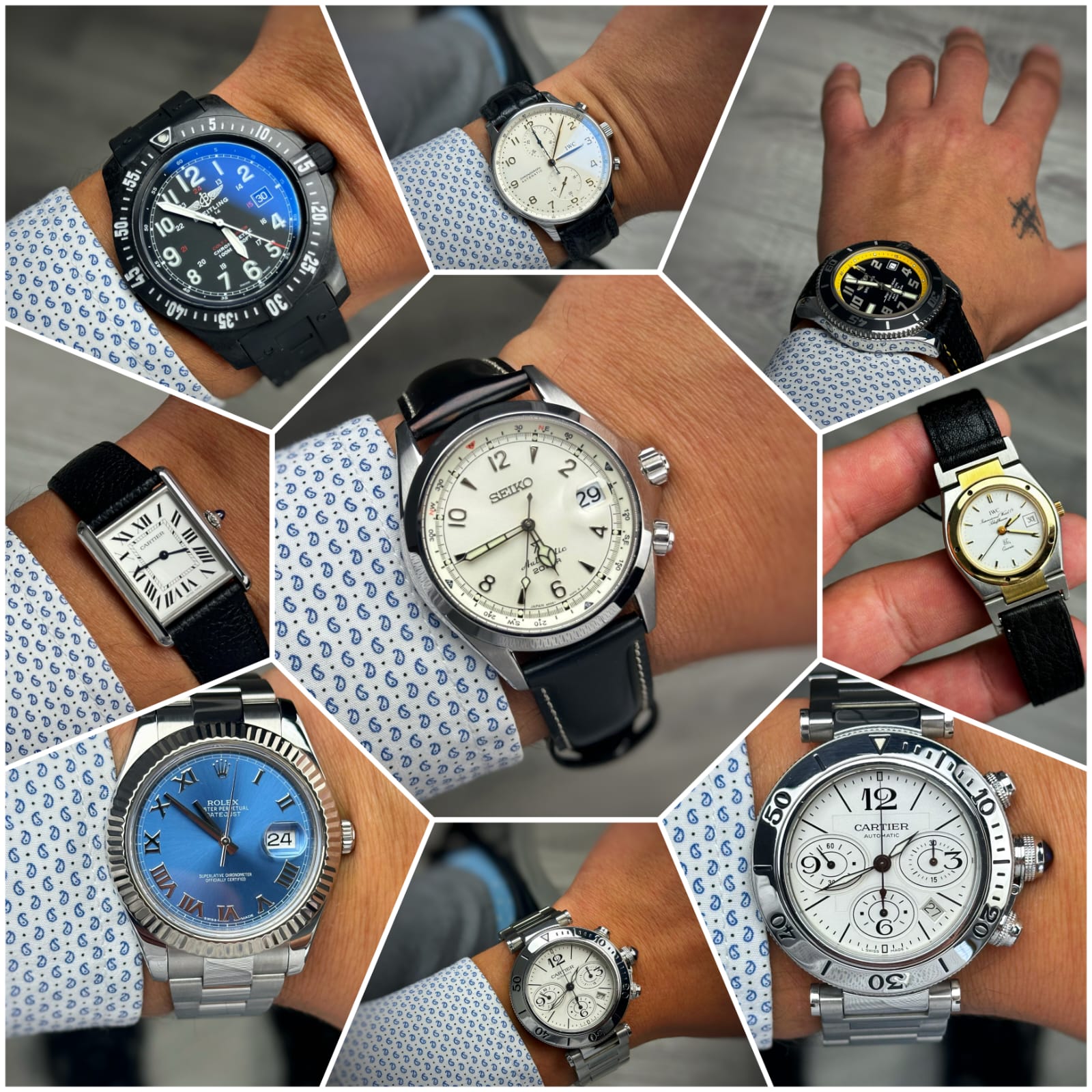
A watch is not only its mechanism, it is also and perhaps above all an ornament, an accessory to please the eye. To some will suit a sports watch, to others a suit-elegant, in other cases a classic watch will work. If we want the watch, to look nice under the shirt, we should be interested in flatter and smaller models. People with delicate smaller hands usually should also bet on more subtle watches (such as Omega De Ville, Cartier Tank, etc.). Sports watches tend to be larger and less subtle. Here we can take under consideration, for example, diver watches (they are distinguished by their water resistance), GMT (they have an additional pointer making a full rotation in 24 hours), or those referring to car racing (e.g. TAG Heuer Monaco). There are also watches that combine elegance with sports, with many manufacturers such as Rolex and Omega creating chronometers designed to be a seamless transition from one style to the other.
So, as you can see, watches are not black magic. The basics needed for an informed purchase, can be mastered in a flash. However, if this entry, still left some doubts, we encourage you to visit our showroom in Warsaw. Our team will be happy to advise you on which watch to choose.

Masz pytania? Chcesz porozmawiać? Chętnie pomożemy!
Pozostaw kontakt lub zadzwoń do nas.
Przed przyjazdem koniecznie umów spotkanie.
Przed przyjazdem koniecznie zadzwoń!
